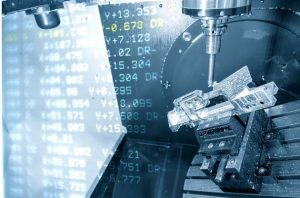
CNC Milling: The basis for manufacturing complex shapes
If you look around you, a large part of the metal parts that are not cylindrical have gone through a milling machine. At Bimetall we often receive requests where the client hesitates between different machining processes.
This guide lays it all out. I explain exactly what milling is, how it differs from other techniques, and why it’s (probably) what you need for prismatic or complex parts.
What is CNC Milling?
CNC milling is a subtractive manufacturing process where a rotating cutting tool removes material from a workpiece that is held fixed (or moves in X, Y, Z coordinates).
Unlike turning , where the piece rotates and the tool is static, here it is the tool that does the work. The machine reads a code (G-Code) extracted from the CAD design and executes movements with micrometric precision.
This allows you to create flat faces, slots, pockets, offset holes and complex 3D profiles that would be impossible to make on a conventional lathe.
Types of Milling Machines: Vertical vs. Horizontal
Not all machines are used for the same purpose. In the workshop we usually decide which machine to use based on the geometry of your piece and the volume of the series.
Vertical Milling (VMC)
The head axis is oriented vertically. The tool descends towards the workpiece.
- Best for: Flat parts, plates, molds, and most general work.
- Advantage: It is cheaper to configure and ideal for visual accessibility for the operator.
Horizontal Milling (HMC)
The axis is horizontal. This allows the chips to fall by gravity, preventing them from being re-cut and damaging the surface finish.
- Best for: Longer series productions or parts that require machining multiple faces without re-clamping the part.
- Advantage: Greater rigidity and chip evacuation speed.
Materials suitable for milling
Milling is versatile, but cutting parameters change drastically. At Bimetall we commonly work with:
- Soft metals: Aluminum (6061, 7075) is milled at high speeds. It is the king of prototyping and the aerospace industry due to its weight-to-strength ratio.
- Hard metals: Stainless steels (304, 316) or carbon steels require carbide tools and constant cooling to prevent thermal hardening.
- Technical plastics: Delrin, Nylon or PEEK. Here the challenge is not hardness, but preventing the material from melting or deforming due to the pressure of the jaw.
Practical applications: When to choose Milling?
Use CNC milling if your part meets any of these conditions:
- Non-cylindrical geometry: Square blocks, supports, housings.
- Internal details: Pockets, slots or holes that are not in the center of the piece.
- Specific surface finishes: You need perfect flatness on one side to guarantee tightness.
If your part requires extremely complex geometries or organic curves, we may need to jump to 5-axis machining , which is an evolution of traditional milling.
The role of Bimetall in Catalonia and France
From our plant in Girona, we manage milling projects that require tight tolerances. We are not a massive “machine farm”; we are a precision workshop.
This means we review your plan. If we see that a slot can be made more efficiently with a slotter instead of milling, we will tell you to save costs.
Do you have a ready design? Send us the STEP or IGES and we will assess whether milling is the appropriate technique.